
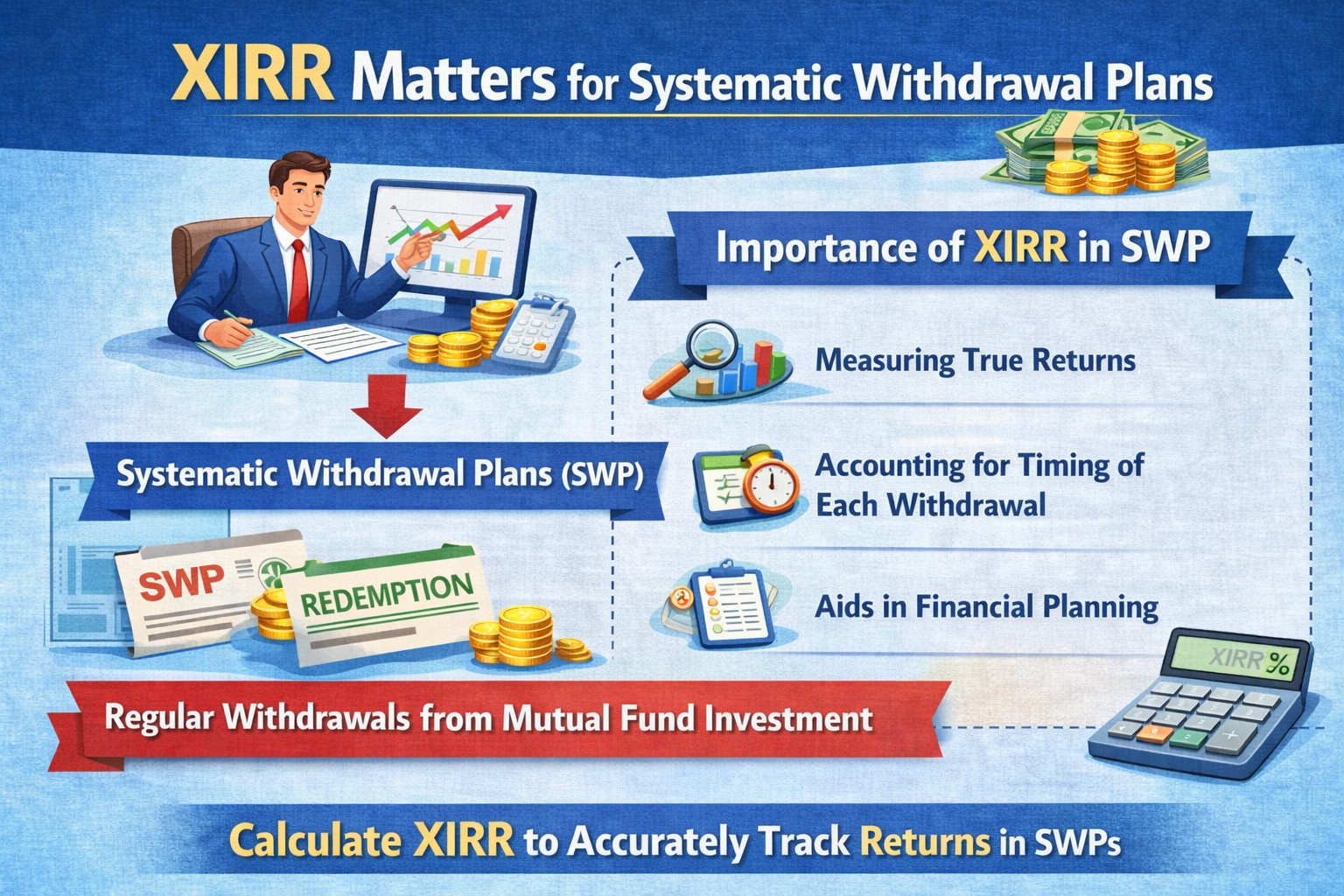
Systematic Withdrawal Plans (SWPs) have become one of the most popular products for those seeking regular cash flow and capital appreciation. SWPs, which are meant primarily for retirees, allow you to withdraw a fixed amount at periodic intervals from your mutual funds or other relevant market-linked instruments. Though they offer flexibility and a steady stream of income, what we need to know, pertinently, is the role of XIRR (Extended Internal Rate of Return) in measuring the actual effectiveness and efficiency of an SWP. This article explains the non-optional XIRR concept in relation to SWPs and uses Indian rupees for easy understanding.
Understanding Systematic Withdrawal Plans (SWPs)
With a systematic withdrawal plan, an investor can withdraw specified amounts of money at regular intervals from an investment account (for instance, monthly, quarterly, or annually). Such withdrawals may be fixed-rupee or discretionary. SWPs provide investors with the benefit of a regular inflow of money and wealth generation through compounding on the invested corpus.
SWPs, as a rule of thumb, are chosen by either retirees who want to replace a paycheck or by investors who want a passive income stream from money they’ve socked away. The plans are also sufficiently customizable; account holders can select their withdrawal schedule, amount, and frequency based on their financial goals and needs.
Introducing XIRR
XIRR in Mutual Funds XIRR, or the Extended Internal Rate of Return, can be used to evaluate? You should assess the returns you are generating from your Investment over the period you have held it, considering cash flows such as outflows and further inflows. In contrast to the CAGR, which assumes reinvestment at a constant rate with consistent input periods, XIRR accounts for timing and any variation in cash flows.
For SWPs, you need XIRR because withdrawals are treated as cash outflows during the investment period. With XIRR calculations, investors can determine whether their withdrawal behavior can be sustained over a longer period in the portfolio’s performance.
Why XIRR Matters in SWPs
Tracking Actual Returns:
Since you are doing SWPs, there will be periodic withdrawals, which may create a difference when calculating returns using conventional measures like CAGR. XIRR gives an accurate picture of the returns the investor has been earning if it takes the load factor into account.
For example:
Let’s assume an investor makes an initial investment of र10,00,000 in mutual funds through SWP. This is what their withdrawals and annual returns could look like over the course of three years:
| Year | Withdrawal | Ending Portfolio Value |
| Year 1 | ₹1,00,000 | ₹9,50,000 |
| Year 2 | ₹1,00,000 | ₹8,60,000 |
| Year 3 | ₹1,00,000 | ₹7,50,000 |
When we consider growth rates using the CAGR formula, we ignore cash flow dynamics. XIRR accounts for these withdrawals and provides the investor with a sophisticated measure of their portfolio’s annual return.
Sustainability Assessment:
SWPs guarantee a regular stream of income but will hurt the Investment if withdrawals exceed interest earned. XIRR is used to verify that the selected withdrawal amount also matches the corpus’s achievable growth rate. To the extent that their business does not meet expected standards, adjustments to withdrawal quantities may be necessary to conserve capital funds.
Comparing SWP Strategies:
Various SWP strategies or types of mutual funds may have different levels of performance. For example, one SWP may be concentrated in equity funds, giving higher returns and more volatility, while another may lean heavily on debt funds that offer stability but lower growth.” By computing XIRR for each, one can compare which approach is more conducive to individual financial goals.
Illustrating XIRR Calculation
To calculate XIRR, you need a table that lists the date and amount of each cash flow (investment inflows or outflows). It’s easier to do this using formulas available in spreadsheet software , such as Excel, or in financial calculators.
Example:
| Year | Withdrawal (Start of Year) | Portfolio Value |
| Year 1 | ₹1,00,000 (Jan 01) | ₹9,50,000 |
| Year 2 | ₹1,00,000 (Jan 01) | ₹8,60,000 |
| Year 3 | ₹1,00,000 (Jan 01) | ₹7,50,000 |
Cash Flow:
01 Jan 2020: ₹-10,00,000(Temporal Investment)
Jan 01 2021: ₹1,00,000
Jan 01 2022: ₹1,00,000
Jan 01 2023: ₹1,00,000
Final Portfolio Value: ₹7,50,000
Using Excel’s XIRR formula, calculate:
= XIRR (Cash Flow Series, Date Series).
Outcome: XIRR ~6.9% (indicative estimate based on assumptions).
This comeback and show backstat how far the Investment really managed to go after a period of periodic withdrawals.
Conclusion
In systematic withdrawal plans, the desired outcome is regular income with capital preservation; therefore, investors need to check and compare returns using tools like XIRR. It examines real-world performance after withdrawals and is designed to help investors plan more effectively, compare efficiently, and align financial decisions with desired outcomes.
Summary
SWP is best for Senior Citizens/Retired persons seeking a steady income. Understanding the importance of XIRR is crucial, as it measures investment returns while accounting for withdrawals over time. With SWPs, various cash flows—intermittent inflows and outflows—come into play, which traditional benchmarks like CAGR may not adequately capture. XIRR helps investors assess the sustainability of their withdrawals; it shows the actual yield and allows them to compare strategies over the Investment’s tenure. By performing the right calculations and continuous monitoring, XIRR makes SWP’s decision data-driven and connects the financial results to the investor’s objectives.
Disclaimer: The content is provided for informational purposes only. Investors are recommended to consider, including financial strategies based on market risks and returns, before investing. Trading in the Indian financial market involves significant risk and is not suitable for all investors.